More and more parents ask us a question that goes beyond straight teeth: “Could my child’s crowded teeth or narrow jaw have anything to do with the way they breathe or sleep?” Adults ask a version of it too. It is a fair question, and it deserves a careful, honest answer.
This guide to orthodontics and airway health explains what “airway” means in orthodontics, the signs worth paying attention to, what an orthodontist can and cannot do, and why a physician or sleep specialist always belongs in the conversation when sleep-disordered breathing is suspected.
What Airway Health Means in Orthodontics
When orthodontists talk about the airway, we mean the passages behind the nose and mouth that air travels through, especially during sleep. Many structures shape that space, including:
- The width of the upper jaw (maxilla) and the shape of the palate, which is also the floor of the nose
- The position of the lower jaw (mandible) relative to the upper jaw
- How much room the tongue has, and where it rests
- Soft tissues such as the tonsils, adenoids and soft palate
Orthodontic treatment can influence some of these, mainly jaw width, jaw relationships and the shape of the dental arches. It does not change the tonsils, adenoids or nasal tissues, and those are often the main factors in children. That is why we think of airway concerns as a team effort rather than something braces or an appliance can solve alone.
Signs Worth Mentioning to Your Child’s Doctor and Orthodontist
None of the signs below proves there is an airway problem. Children mouth-breathe during colds and allergy season, and plenty of kids with crowded teeth sleep perfectly well. Still, these are reasonable things to bring up, especially when several show up together or last for months.
Breathing and sleep signs
- Snoring on most nights, or noisy, labored breathing during sleep
- Pauses in breathing, gasping or snorting during sleep
- Mouth breathing most of the time, day and night, rather than only when congested
- Restless sleep or unusual sleeping positions
- Daytime sleepiness, irritability or trouble focusing
The American Academy of Pediatrics recommends that pediatricians ask about snoring at routine checkups, and that a child who snores regularly and has other signs of obstructive sleep apnea be evaluated further, usually with an overnight sleep study (AAP clinical practice guideline). MedlinePlus and the American Academy of Sleep Medicine describe similar warning signs for families (MedlinePlus: Pediatric sleep apnea; AASM Sleep Education: Child sleep apnea).
Dental and jaw signs
- A narrow, high-arched palate or a V-shaped upper arch
- A crossbite, where upper back teeth bite inside the lower teeth
- Significant crowding, particularly in the upper jaw
- An open bite, or lips that rest apart instead of comfortably closed
- A lower jaw that sits well behind the upper jaw
On their own, these are orthodontic findings, not a diagnosis of a breathing disorder.
What an Airway-Conscious Orthodontic Evaluation Includes
An orthodontic exam always looks at the teeth, the bite and how the jaws are growing. When a family raises breathing or sleep concerns, we also take time to:
- Review the health and sleep history: snoring, mouth breathing, allergies, and any previous tonsil or adenoid evaluations
- Assess upper jaw width, palate shape and the front-to-back relationship of the jaws
- Note lip posture at rest and whether nose breathing seems easy
- Recommend X-rays or a digital scan only when they are needed to plan treatment
Just as important is what we do not do. Orthodontists do not diagnose sleep apnea. The American Association of Orthodontists’ white paper on the subject is clear that orthodontists can screen for warning signs and refer, but the definitive diagnosis of obstructive sleep apnea must be made by a physician, and airway images taken in a dental office should not be used to diagnose it (AAO White Paper: Obstructive Sleep Apnea and Orthodontics). If we see a pattern that concerns us, we explain it plainly and recommend that you talk with your pediatrician or physician, who may involve an ENT or a sleep specialist.
How Orthodontic Treatment Can Fit In
Palatal expansion for a narrow upper jaw
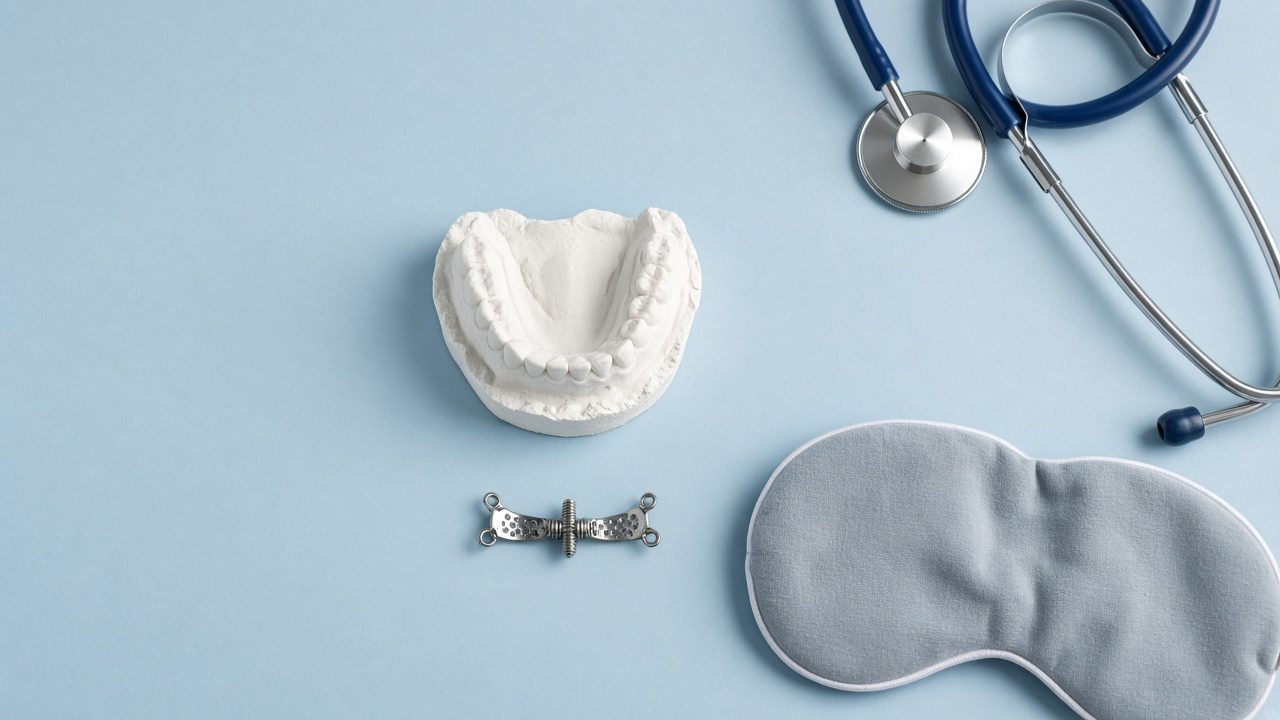
When a growing child has a genuinely narrow upper jaw, often with a crossbite, a palatal expander can widen it while the midline growth area in the palate is still responsive. The main goals are orthodontic: correcting the crossbite, improving how the jaws fit, and making room for permanent teeth. The AAO white paper notes that expansion can also reduce nasal airway resistance in some children, and that low-level evidence suggests it may lower sleep-study scores in some children already diagnosed with sleep apnea. It also cautions that most studies lacked untreated comparison groups, that expanders should be used only when there is a real skeletal reason, and that there is no evidence expansion prevents sleep apnea later in life.
Early (Phase I) treatment
Some children benefit from a short first phase of treatment to address crossbites, severe crowding or jaw imbalances while they are still growing. You can read more about this in our guide to interceptive orthodontic treatment and in Phase I vs. Phase II treatment. Often the right answer is simply to monitor growth and check back in.
Teens and adults
Once growth is finished, braces or Invisalign can correct crowding and bite problems, but they do not widen the jaw bones the same way. For adults diagnosed with sleep apnea, a sleep physician may consider options that include oral appliances or, for significant jaw discrepancies, jaw surgery with an oral and maxillofacial surgeon. Orthodontics can be one part of that plan, not a substitute for medical treatment.
Orthodontics and Airway Health: Why a Team Approach Matters
In children, enlarged tonsils and adenoids are the most common risk factor for obstructive sleep apnea, and removing them is typically the first-line treatment when they are the cause (AAP). Allergies and nasal congestion may need medical care, too. Depending on the situation, your child’s care team might include a pediatrician, an ENT, an allergist, a sleep medicine physician, your family or pediatric dentist, and us. With your permission, we are glad to share our findings with your child’s doctors so everyone is working from the same picture.
For a closer look at the medical side, see our article on sleep apnea and children.
When to Schedule an Evaluation
The AAO recommends that every child see an orthodontist by age 7, or sooner if something seems off (AAO: Orthodontics for Children). An evaluation is not a commitment to treatment. If your child mouth-breathes, has a crossbite or crowding, or you are an adult with bite concerns and possible sleep symptoms, a conversation with an orthodontist is a reasonable step, alongside a visit with your physician.
We offer free consultations at our Lombard and Orland Park offices. You can see how a first visit works in what to expect at your first orthodontic consultation, and call either office when you are ready: Lombard at (630) 424-9070 or Orland Park at (708) 377-0777.
Frequently Asked Questions
Can braces or an expander cure my child’s sleep apnea?
No orthodontic treatment should be thought of as a cure. Sleep apnea is a medical diagnosis made by a physician, and in children the first-line treatment is often tonsil and adenoid removal. Expansion may help some children who also have a narrow upper jaw, as part of a plan guided by their physician.
Does mouth breathing always mean something is wrong?
Not at all. Temporary mouth breathing during a cold or allergy flare is common. Mention it to your pediatrician if it happens most of the time or comes with snoring or restless sleep.
My child snores. Should I see an orthodontist or a doctor first?
Start with your pediatrician, who can decide whether a sleep study or ENT referral is needed. An orthodontic evaluation can run alongside that to look at jaw width and bite.
Can adults benefit from an airway-conscious evaluation?
Yes. If sleep apnea is suspected, diagnosis and treatment decisions belong with a sleep physician; orthodontics may play a supporting role.
Sources
- American Association of Orthodontists. White Paper: Obstructive Sleep Apnea and Orthodontics (2019)
- American Academy of Pediatrics. Diagnosis and Management of Childhood Obstructive Sleep Apnea Syndrome. Pediatrics, 2012
- MedlinePlus (NIH). Pediatric sleep apnea
- American Academy of Sleep Medicine, Sleep Education. Child sleep apnea
- American Association of Orthodontists. Orthodontics for Children