Most parents we meet are a little surprised when their dentist mentions an orthodontist for a seven-year-old. Braces feel like a middle school thing. But a child’s first orthodontist visit usually happens well before anyone is talking about braces, and for most kids it’s simply a check to make sure the bite and jaws are growing the way they should. At Othman Orthodontics, Dr. Hasan Othman, DDS, MS, sees families from Lombard, Orland Park, and the surrounding suburbs every week for exactly this reason.
Below we’ll walk you through what we actually look for, what the appointment is like from your child’s point of view, what to bring, and where early treatment (including Invisalign First) fits in. We’ll also be honest about what early treatment can’t do.
Why the First Orthodontist Visit Happens Around Age 7
The American Association of Orthodontists recommends that children have an orthodontic checkup by age 7. We get it if that sounds early. Your child may still have a mouth full of baby teeth.
That mix is the point, though. By around seven, the first permanent molars have usually come in and the front teeth are starting to change over. Those molars set up how the back teeth come together, so this is a good moment to see how the upper and lower jaws relate to each other and whether there’s likely to be enough room for the permanent teeth still on the way.
Here’s the part parents tend to find reassuring: a first orthodontist visit at seven does not mean your child is about to get braces. Plenty of the kids we see at this age are right on track, and we tell their parents so. When something does need attention, catching it while the jaws are still growing gives you more choices and more time to think them over.
If you’d like a broader picture of how we work with younger patients, our orthodontics for children page is a good place to start.
Things You Might Notice at Home
Age 7 is a guideline, not a rule. There’s no minimum age for a first orthodontist visit, and if something catches your eye before then, it’s fine to call.
Pay attention to how your child loses baby teeth. Losing them much earlier or much later than classmates can be a clue that something is going on underneath. Look at the front teeth, too. Are they crowded and overlapping, spaced widely apart, or sticking out noticeably past the lower teeth? Ask your child to bite down and smile. If the top and bottom front teeth don’t meet, or the upper teeth sit behind the lower ones in places, that’s worth having us look at.
Some signs are less about the teeth themselves:
- Breathing through the mouth much of the time, or snoring
- Thumb or finger sucking that continues past the toddler years
- Trouble chewing or biting into food
- A jaw that shifts to one side, clicks, or pops
- Frequently biting the cheek or the roof of the mouth
- Jaws or teeth that look out of proportion with the rest of the face
None of these automatically means treatment. They’re simply good reasons to book a first orthodontist visit a little sooner. And if your family dentist suggests an orthodontic evaluation at a routine cleaning, we’d encourage you to follow through.
What Actually Happens at a First Orthodontist Visit
New places can make kids nervous, and honestly, parents too. So here’s a plain description of the appointment, start to finish.
When you arrive, our team will check you in and get you settled. You’ll fill out some basic health and dental history, and if you’ve noticed anything at home, this is a great time to mention it.
The exam during your child’s first orthodontist visit
Dr. Othman will look at your child’s teeth, bite, and jaws, and he may ask your child to open, close, and bite down a few times. There are no needles and nothing that hurts. Kids usually find it a lot less dramatic than a cleaning. Depending on what he sees, our team may take photos or X-rays so he has a fuller picture of how things are developing, including teeth that haven’t come in yet.
The conversation afterward
Once the exam is done, Dr. Othman will sit down with you and explain what he found in everyday language. Typically, that lands in one of three places: everything looks normal, things are worth keeping an eye on, or early treatment may help. He’ll tell you why, and you’re welcome to ask as many questions as you like. No one will push you to decide anything that day.
As for timing, the length of the appointment depends on whether records are taken, so just ask when you call and we’ll tell you how much time to plan for. Our initial visit page has more detail. The consultation itself is free, which takes a lot of the pressure off.
What to bring to the first orthodontist visit
You don’t need much. A short list helps:
- Your insurance card, if you have dental insurance
- Any recent X-rays or records from your family dentist, if they’re easy to get
- A list of questions or things you’ve noticed at home
Have your child brush before you come. On the way, keep it simple: the orthodontist is going to look at and count their teeth. We’d skip words like “hurt” or “shot,” since kids tend to fixate on them even when you’re saying it won’t happen.
Watching and Waiting vs. Early Treatment
Most children who come in young don’t need treatment right away. For many, the best plan is to check back periodically as more permanent teeth arrive. We call this monitoring. It lets us time treatment well if it’s ever needed, rather than starting too early or too late.
For some kids, early treatment (often called Phase 1) makes real sense. It might be recommended to guide jaw growth, make room for crowded permanent teeth, correct a crossbite, help with a habit that’s affecting the bite, or lower the risk of injury to front teeth that stick out.
Treatment that focuses on how the jaws grow and develop is called dentofacial orthopedics, and you can read more on our dentofacial orthopedics page. Depending on the child, we might use one of several appliances; our types of orthodontic appliances page explains the options.
What early treatment can and can’t do
We think parents deserve a straight answer here. Early treatment works with growth that’s already happening, which can make some problems easier to address than they’d be later. It can create space, correct how the jaws line up, and in some cases simplify what comes next.
What it usually can’t do is replace every future step. Many children who have Phase 1 treatment still need a second phase once all their permanent teeth are in, often with braces or aligners. Results also depend a lot on cooperation at home, whether that means wearing an appliance as directed or keeping up with check-ins. Dr. Othman will tell you honestly whether early treatment is likely to help your child, or whether waiting is the smarter move.
Where Invisalign First Fits In
If early treatment is recommended, a lot of parents ask whether there’s an option without a traditional appliance. For some kids, there is. Invisalign First is a clear aligner system made for children who still have a mix of baby and permanent teeth.
It works with a series of custom, removable clear aligners, each one moving the teeth a small amount. The system is designed with growing mouths in mind, so it accounts for teeth that are still coming in and baby teeth that will fall out along the way.
Families tend to like a few things about it. The aligners come out for meals, so kids can keep eating what they normally eat. Brushing and flossing are simpler without brackets and wires. Smooth plastic is gentler on cheeks than metal parts, and clear aligners are hard to notice at school, which matters more to some kids than you might expect.
Is your child a good fit?
Invisalign First isn’t right for every child. Whether it works depends on the specific bite problem and on your child actually wearing the aligners, which is usually most of the day. During the first orthodontist visit, Dr. Othman can tell you whether Invisalign First, another appliance, or simply monitoring makes the most sense.
Even If Nothing Is Needed
A lot of families leave their child’s first orthodontist visit with the news that everything looks fine. That’s a good outcome, not a wasted trip. You’ll know what to watch for as your child grows, you’ll have a team to call when questions come up, and your child will already know our office if they come back later.
About Dr. Hasan Othman
Dr. Hasan Othman, DDS, MS, treats patients of all ages, and he puts a lot of weight on listening and explaining options clearly so families can make decisions they feel good about. You can read more about his background on our Meet Dr. Hasan Othman page.
Our Two Offices
We see families across Chicago’s western and southwest suburbs at two locations.
Lombard Office
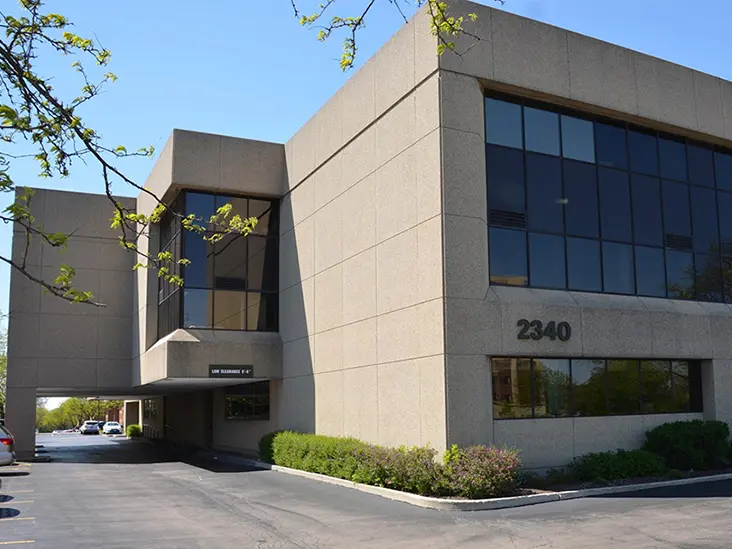
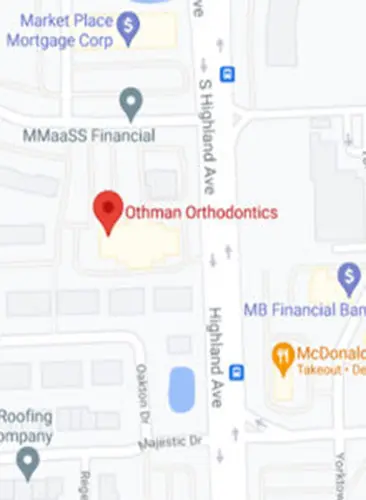
2340 S. Highland Ave, Suite 310, Lombard, IL
Phone: (630) 424-9070
Close by for families in Lombard, Downers Grove, Oakbrook, and Elmhurst. Visit our Lombard location page.
Orland Park Office
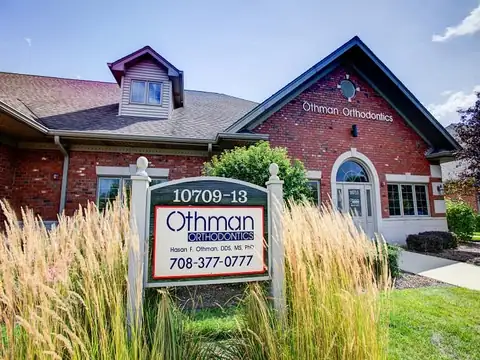
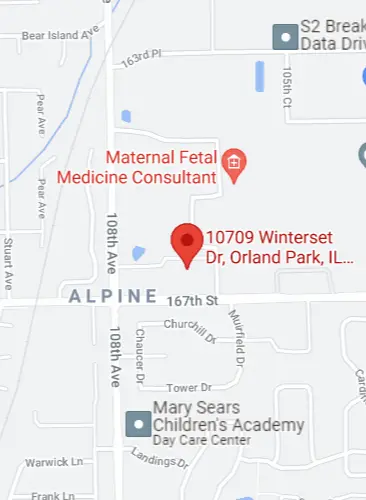
10709 Winterset Dr, Orland Park, IL
Phone: (708) 377-0777
Close by for families in Orland Park, Tinley Park, Palos Heights, and Homer Glen. Visit our Orland Park location page.
Frequently Asked Questions
What age should my child have a first orthodontist visit?
The American Association of Orthodontists recommends a checkup by age 7. If you notice something before then, you can schedule earlier.
Do we need a referral from our dentist?
No. You’re welcome to call us directly to set up a consultation.
Will my child need braces right away?
Probably not. Many children only need monitoring until more permanent teeth come in. Dr. Othman recommends early treatment only when it makes sense for your child.
Does the first orthodontist visit hurt?
No. The exam is gentle and there are no needles. Most kids are surprised by how easy it is.
Is Invisalign First right for my child?
It depends on your child’s bite, how their teeth are developing, and whether they can wear the aligners as directed. Dr. Othman can tell you during the consultation.
How much does the consultation cost?
The orthodontic consultation is free, with no pressure to start anything.
Book Your Child’s First Orthodontist Visit
Whether your child is getting close to seven or you’ve noticed something that’s been nagging at you, we’d be glad to meet your family and take a look. You can request a free consultation on our appointment request page, or call our Lombard office at (630) 424-9070 or our Orland Park office at (708) 377-0777. A first orthodontist visit is a small step, and it usually answers a lot of questions at once.