“Will I talk funny?” It is one of the most common questions we hear, from second graders getting an expander to professionals who give presentations for a living. The honest answer is that some appliances can change how you sound for a little while, and the tongue is remarkably good at adapting. Knowing what to expect, and how to practice, makes the adjustment much easier.
So, do braces affect speech? Here is how each type of appliance tends to affect it, how long the changes usually last, and what to do if speech concerns go beyond a normal adjustment period.
Why Appliances Can Change How You Sound
Clear speech depends on the tongue touching precise spots behind the front teeth and on the roof of the mouth. Sounds like “s,” “z,” “sh,” “ch,” “t,” “d” and “l” are especially sensitive to small changes in that space. Anything that sits on the palate or behind the teeth, or adds a thin layer over the teeth, changes the landing spots slightly. Your tongue then has to relearn them. That relearning is the adjustment period most patients notice.
Traditional Braces
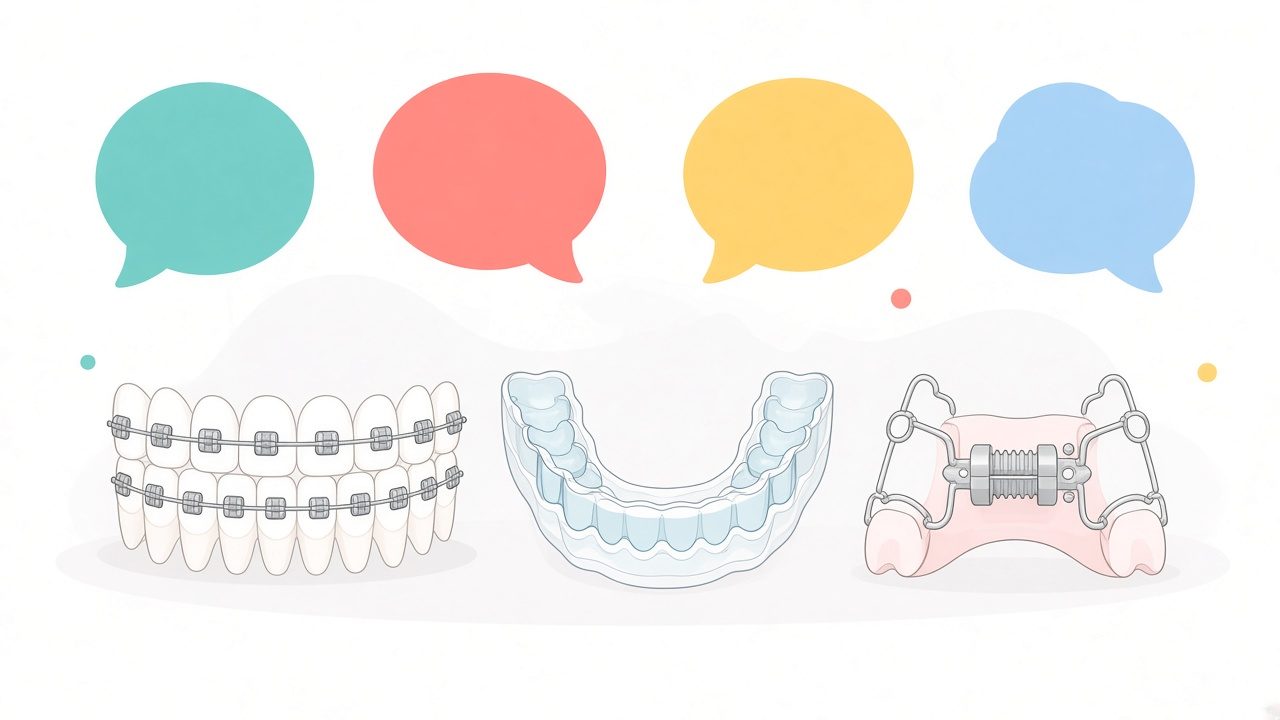
Metal and clear (ceramic) braces sit on the front surfaces of the teeth, away from most of the tongue’s work. According to the American Association of Orthodontists, braces do not mean you will have a lisp for your whole treatment. When patients notice a change, it is usually with “s” and “th” sounds shortly after the braces are placed, and sometimes with “t” and “d” (AAO: Do Braces Change How You Talk?).
Most of the early awkwardness comes from lips and cheeks getting used to the brackets, and from mild soreness in the first days. For most people this fades quickly. If you are weighing options, our types of braces page compares them side by side.
Palatal Expanders
An expander sits on the roof of the mouth, right where the tongue goes to form many sounds. So it is normal for children to sound a bit different at first. The AAO notes that expanders commonly cause temporary changes in speech and extra saliva while the tongue adjusts (AAO: Palatal Expanders).
What parents may notice
- A slight lisp, or “thicker” sounding speech, particularly on “s,” “sh,” “ch” and “j”
- More saliva and extra swallowing in the first days
- Some self-consciousness, especially if the change is noticeable at school
Helping your child adapt
- Read aloud together for a few minutes each day. Picture books, comics and song lyrics all count.
- Practice tongue-twisters with “s” and “sh” sounds and make it a game, not a test.
- Let teachers know an expander is new so they can be patient during the first week or two.
- Reassure your child that this phase is temporary and that most kids adapt quickly.
Expanders are often part of early treatment; you can learn more about why in our guide to interceptive orthodontic treatment.
Invisalign and Other Clear Aligners
Aligners cover the teeth with a thin layer of plastic, which slightly changes the surfaces the tongue touches. Some patients notice a mild lisp on “s” sounds when they start, and a day or so of “new tray” feel with each new set. Many people find the change subtle enough that others do not notice.
Tips for aligner wearers
- Wear your aligners as directed. Taking them out often to talk tends to slow the adjustment, because your tongue never fully gets used to them.
- Practice speaking and reading aloud with aligners in, especially in the first week.
- If you have a big presentation, try to switch to a new set a day or two beforehand rather than the morning of.
Learn more about how aligner treatment works on our Invisalign page.
Lingual and Incognito Braces
Lingual braces such as Incognito are attached to the back surfaces of the teeth, so they are hidden from view but share space with the tongue. A systematic review of the research found that lingual braces and palatal expanders clearly affect speech, most often “s,” “t” and “d” sounds. Most changes resolved within weeks, although a slight “s” distortion lasted longer in some patients (European Journal of Orthodontics systematic review). Patients may also notice some tongue tenderness at first.
With daily practice, most patients see steady improvement over the following weeks. Orthodontic wax over any spot that irritates the tongue can make practicing more comfortable. If you speak for a living and are drawn to lingual braces, let us know at your consultation so we can talk honestly about the adjustment and plan the start date around your calendar.
Do Braces Affect Speech Long Term?
Everyone adapts at their own pace, but a general pattern looks like this:
- Braces on the front of the teeth: little or no change for most people, usually settling within days
- Expanders: a more noticeable adjustment, typically improving over the first couple of weeks
- Clear aligners: mild and short-lived for most people, sometimes a brief “new tray” period with each set
- Lingual braces: the most noticeable at first, improving over several weeks with practice
If a speech change seems to be getting worse instead of better, or has not improved after a few weeks, call us. Sometimes a small adjustment to the appliance helps.
Can Orthodontic Treatment Improve Speech?
Orthodontics is not speech therapy. That said, certain bite problems can make some sounds harder to produce. Examples include an open bite, where the front teeth do not meet, or front teeth that stick out significantly. Correcting the bite may make it easier for the tongue to find its natural positions. We cannot promise that straightening teeth will change how someone speaks, though.
When a child or adult has a true speech sound difficulty, the right professional is a speech-language pathologist (SLP). You can find a certified SLP through the American Speech-Language-Hearing Association’s ProFind directory. Your pediatrician or your child’s school can also help. When a patient is working with an SLP, we are glad to coordinate so that appliance timing and therapy goals support each other.
Planning Around Big Moments
- Schedule a new expander or lingual braces away from recitals, plays, debates or major presentations when you can.
- Singers and wind-instrument players should mention it at the consultation, because the choice of appliance and timing can matter.
- Give teachers, coaches or managers a heads-up if you expect a brief adjustment period.
Questions About Your Treatment and Speech?
If speech is part of your decision, bring it up at your consultation. We will explain how each option is likely to feel for you or your child and help you choose a plan that fits school, work and everything in between. Consultations are free at both our Lombard and Orland Park offices: call (630) 424-9070 for Lombard or (708) 377-0777 for Orland Park.
Frequently Asked Questions
Will braces give me a permanent lisp?
No. A slight lisp at the start is common for some patients, and speech normally returns to normal as your mouth adapts. If it does not improve after a few weeks, let us know.
Which option affects speech the least?
For most people, braces on the front of the teeth and clear aligners cause the smallest and shortest changes. Lingual braces and expanders tend to need a longer adjustment because they share space with the tongue.
Should my child see a speech therapist during orthodontic treatment?
If your child had speech concerns before treatment, or has trouble that does not fade after the normal adjustment period, ask your pediatrician or school about an evaluation with a speech-language pathologist. We are happy to coordinate with them.
Can I take my aligners out for an important meeting?
Occasionally, yes, but wear time matters for treatment progress, and frequent removal can make speech adjustment take longer. Follow the wear schedule we give you.
Sources
- American Association of Orthodontists. Do Braces Change How You Talk?
- American Association of Orthodontists. What Are Palatal Expanders and What Do They Correct?
- Speech and orthodontic appliances: a systematic literature review. European Journal of Orthodontics, 2018;40(1):29–36
- American Speech-Language-Hearing Association. ProFind: Find a Certified Professional